Custom Metal Fabrication Shop
Overview
PRESERVED SHOP RECORD Domain: canadianmillequipment.com Record type: legacy equipment listing and company description Status: former plant is not quoting from this domain The preserved pages read like a working inventory rather than a sales brochure. The cart page carries a count of fifty-nine items, and the line items are written in the shorthand of a mill equipment yard: main sizes, arbor types, feeder lengths, blower diameters, motor horsepower, chain conveyor lengths, sorter bins, screen dimensions, and moulder head counts. The about page explains the company as a seller or broker of used, reconditioned, or rebuilt wood processing equipment. It handles individual pieces, entire lines, and complete mills. Sawmilling equipment runs from log yard and handling through primary and secondary breakdown, planer, reman, and added value mills. Additional forest related processing equipment in
Details
cludes veneer, plywood, composite board, co-gen plants, and other specialty plants. The company works with the client to assemble rebuilt components alongside new equipment to provide efficient wood processing at prices substantially less than new. That is the heritage frame. The target topic is a custom metal fabrication shop. The preserved record does not quote from this domain, and the former plant is not quoting from this domain. So the shop record must stay inside the process language that the preserved pages already use: breakdown, handling, conveying, chipping, screening, resawing, edging, moulding, hydraulic power, air strain, blower pressure, chain return, troughing belt, end squeeze, sorter bins, and rebuilt components joined with new equipment. A custom metal fabrication shop that serves this kind of plant does not begin with a catalog. It begins with a fit-up. The shop process language starts at the breakdown of a machine or a line. A customer brings a worn component, a damaged frame, a replacement chute, a transition piece, a guard package, a base, a bracket set, or a rebuilt assembly. The shop reads the existing geometry. It checks the mounting hole pattern, the wear surfaces, the shaft centers, the flange faces, the bolt circle, the keyway, the bearing fits, and the clearance to adjacent equipment. If the original drawing is missing, the shop works from the preserved piece, from a template, or from field measurements. The first output is not a finished part. It is a fabrication plan. The plan moves through cutting, forming, fitting, welding, machining, and trial assembly. Cutting may be plate shear, band saw, plasma, or oxy-fuel, depending on thickness and material. Forming may be press brake, roll, or flame straightening. Fitting is where the shop earns its keep. A custom metal fabrication shop aligns members, sets diagonals, checks square, and tacks the assembly before final weld. The welder follows a sequence to control distortion. After welding, the part may go to machining for bored holes, faced flanges, milled pads, or turned journals. Then it goes to trial assembly against a mating piece or a fixture. In the preserved equipment language, that process shows up in specific items. A double arbor gang, a vertical double arbor gang edger, a top arbor combination edger, a linebar resaw, a twin bandmill, a hammer hog, a chipper, a chip screen, a bar moulder, a step feeder, a chain conveyor with return, a troughing belt conveyor, an end squeeze, a hydraulic power unit, a high pressure blower, and a J bar sorter all depend on fabricated structures and rebuilt components. The custom metal fabrication shop supports those items by making replacement frames, chutes, hoppers, transitions, guards, bases, wear liners, sprocket mounts, bearing housings, shaft assemblies, and conveyor sections. It also supports the hydraulic and pneumatic side: reservoir skids, cylinder mounts, manifold brackets, pipe supports, and air strain components. The shop language is practical. It talks about fit, clearance, runout, flatness, square, plumb, level, and alignment. It talks about weld size, weld sequence, back gouging, preheat, interpass temperature, and stress relief when the material and thickness require it. It talks about bolt holes being match-drilled, slotted, or reamed on assembly. It talks about wear plate, liner plate, abrasion resistant plate, mild steel, stainless, and aluminum. It talks about surface preparation and coating systems, but it does not invent certifications. It does not claim a stamp it does not hold. It does not promise a code it cannot document. The preserved about page says the company assembles rebuilt components with new equipment. A custom metal fabrication shop fits that same logic. It can rebuild a damaged component to original function, or it can fabricate a new component that interfaces with existing equipment. The work is often a hybrid: new steel where the old steel is fatigued, reused machined parts where the fits are still good, and new wear surfaces where the abrasion is heaviest. The shop measures the old assembly, builds the new one, and checks it against the mating equipment before it leaves the floor. The preserved cart page lists equipment by size and function. That is also how a custom metal fabrication shop should be read. It is not a catalog of standard products. It is a capability to take a size, a function, and an interface, and produce a metal assembly that fits the line. The shop record stays inside that process language: breakdown, handling, primary and secondary, planer, reman, added value, veneer, plywood, composite board, co-gen, specialty plants, rebuilt components, new equipment, efficient processing. No prices. No RFQ forms. No street addresses. No phone numbers. No URLs. No invented certifications. Just the preserved shop record and the fabrication process it implies.
Drill size reference
| Drill | Decimal inch | Millimetres |
|---|---|---|
| #1 | 0.2280 | 5.791 |
| #7 | 0.2010 | 5.105 |
| #13 | 0.1850 | 4.699 |
| #21 | 0.1590 | 4.039 |
| #29 | 0.1360 | 3.454 |
| #36 | 0.1065 | 2.705 |
| #43 | 0.0890 | 2.261 |
| #53 | 0.0595 | 1.511 |
| 1/16 | 0.0625 | 1.587 |
| 5/64 | 0.0781 | 1.984 |
| 3/32 | 0.0938 | 2.381 |
| 7/64 | 0.1094 | 2.778 |
| 1/8 | 0.1250 | 3.175 |
| 9/64 | 0.1406 | 3.572 |
| 5/32 | 0.1562 | 3.969 |
| 11/64 | 0.1719 | 4.366 |
| 3/16 | 0.1875 | 4.763 |
| 13/64 | 0.2031 | 5.159 |
| 7/32 | 0.2188 | 5.556 |
| 15/64 | 0.2344 | 5.953 |
| 1/4 | 0.2500 | 6.350 |
| 5/16 | 0.3125 | 7.938 |
| 3/8 | 0.3750 | 9.525 |
| 7/16 | 0.4375 | 11.113 |
| 1/2 | 0.5000 | 12.700 |
| F | 0.2570 | 6.528 |
| H | 0.2660 | 6.756 |
| L | 0.2900 | 7.366 |
| P | 0.3230 | 8.204 |
| S | 0.3480 | 8.839 |
| W | 0.3860 | 9.804 |
| Z | 0.4130 | 10.490 |
Common questions
What is a #1 drill bit in inches and millimetres?
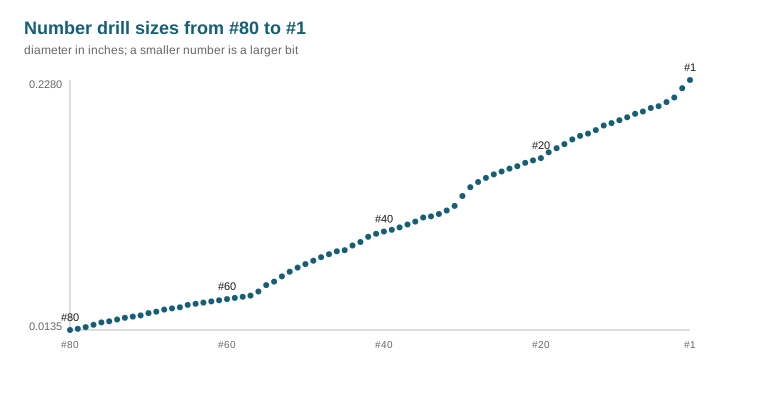
A #1 drill bit is 0.2280 in, which is 5.791 mm. Number drills run from #80 at 0.0135 in up to #1 at 0.2280 in, so a smaller number is always a larger bit.
What is a #7 drill bit in inches and millimetres?
A #7 drill bit is 0.2010 in, which is 5.105 mm. Number drills run from #80 at 0.0135 in up to #1 at 0.2280 in, so a smaller number is always a larger bit.
What is a #13 drill bit in inches and millimetres?
A #13 drill bit is 0.1850 in, which is 4.699 mm. Number drills run from #80 at 0.0135 in up to #1 at 0.2280 in, so a smaller number is always a larger bit.
This page is an archival note for informational purposes only. It does not offer representation, evaluate claims, or create a professional relationship.