Short-Run Metal Fabrication
Overview
Preserved shop record, canadianmillequipment.com. The pages that survive are a cart listing and a company page. The cart page is a working inventory of heavy wood-processing machinery: a 10" x 36" Ukiah double arbor gang, two 10' Linden double acting step feeders, a 12" x 16" Ukiah vertical double arbor gang edger, a 12" x 25" Roots high pressure blower, a 15 HP hydraulic power unit, a 20 HP hydraulic power unit, a 24" x 32" Jeffrey hog, a 30" x 45" Archer chip feeder bare, a 36" CM & E Norman chipper, a 38" Precision chipper, a 4' x 4' x 24' Moore end squeeze, a 40 HP G. Wheeler DC motor, a 40" x 64" Lamb hammer hog, 49 vertical bins, an Irvington Moore J bar sorter, a 50 ft chain conveyor with return, a 50' x 36" troughing belt conveyor, a 54" McDonough linebar resaw, a 6" x 24" Esser edger system with three shifting saws, a 6" x 54" Ukiah top arbor combination edger, a 6' Kockums CanC
Details
ar twin bandmill, a 62" McDonough super duty air strain twin bandmill, a 7' x 19' Nicholson chip screen, an 8 head Weinig bar moulder, and an 8" x 24" Archer high pressure blower. The company page describes the operation as sale or brokering of used, reconditioned or rebuilt wood processing equipment, handling individual pieces through entire lines and complete mills. Sawmilling equipment runs from log yard and handling through primary and secondary break down, planer, re-man and added value mills. Additional forest related processing equipment includes veneer, plywood, composite board, co-gen plants and other specialty plants. The company works with the client to assemble rebuilt components alongside new equipment to provide efficient wood processing at prices substantially less than new. That is the preserved language. It is a shop that thinks in lines, not in single parts. A line is a sequence: log yard and handling, primary break down, secondary break down, planer, re-man, added value. Each station has a feeder, a saw or knife, a conveyor, a screen, a hog, a blower, a power unit, a motor. The inventory names those stations by maker and by size. The process language is dimensional and mechanical. It talks about arbor, gang, edger, resaw, bandmill, chipper, hog, screen, sorter, conveyor, squeeze, blower, power unit, motor, moulder. It talks about top arbor and double arbor, vertical and horizontal, single and twin, shifting saws, air strain, step feeder, linebar, troughing belt, chain with return, end squeeze, bar moulder, chip feeder, chip screen. Short run metal fabrication, read through that same process language, is a line that is set up to break down and re-man a small batch without pretending to be a long run. The preserved shop does not quote from this domain, so the record stays descriptive. The former plant is not quoting from this domain. What remains is the vocabulary of the floor. In a short run metal fabrication line, the log yard and handling equivalent is stock receiving and staging. Plate, sheet, tube, bar, angle, channel, and extrusions arrive and are sorted by size and alloy. The primary break down is cutting to rough length: shear, saw, plasma, or waterjet. The secondary break down is forming and machining: press brake, roll, punch, drill, mill, turn. The planer equivalent is surface preparation and edge work: deburr, grind, chamfer, face, square. The re-man equivalent is fit-up and weld: tack, fixture, weld, cool, straighten. The added value equivalent is finish and assembly: coat, plate, paint, label, package, and load. The equipment names change, but the station logic holds. A short run line still needs a feeder, a saw or knife, a conveyor, a screen, a hog, a blower, a power unit, a motor. In metal, the feeder may be a sheet feeder or a bar feeder. The saw may be a cold saw, an abrasive saw, a band saw, or a shear. The knife may be a punch, a die, a press brake tool, or a laser head. The conveyor may be a roller bed, a belt, a chain, or a transfer. The screen may be a scrap separator or a chip conveyor. The hog may be a scrap chopper or a briquetter. The blower may be a dust collector or a fume extractor. The power unit may be hydraulic, pneumatic, or electric. The motor may be DC or AC, fixed or variable speed. The preserved inventory shows the shop's habit of naming the maker and the size. That habit carries into short run metal fabrication. A press brake is named by tonnage and bed length. A shear is named by thickness and width. A saw is named by capacity and blade type. A punch is named by tonnage and throat. A mill is named by table size and travel. A lathe is named by swing and center distance. A welder is named by process and duty cycle. A positioner is named by capacity and rotation. A fixture is named by the part it holds. The preserved company page says the operation handles all combinations of processing requirements from individual pieces to entire lines as well as complete mills. Short run metal fabrication is the individual piece end of that same logic. It is not a line that runs one part for a year. It is a line that runs one part, then another, then another. The set-up is the work. The fixture is the work. The first article is the work. The rest is repetition until the batch is done. The preserved page also says the company will work with the client in assembling a combination of rebuilt components in conjunction with new equipment to provide efficient processing at prices substantially less than new. Short run metal fabrication uses the same assembly logic. A rebuilt press brake, a new control, a rebuilt shear, a new back gauge, a rebuilt conveyor, a new drive, a rebuilt power unit, a new motor. The line is a combination. The line is assembled to the part. The line is not a monument. The preserved cart page lists 59 items. That is a line in waiting. A short run metal fabrication shop reads that list and sees stations. The Ukiah gang is a break down. The Linden step feeder is a feeder. The Roots blower is air. The hydraulic power unit is power. The Jeffrey hog is scrap. The Archer chip feeder is feed. The Norman chipper is size reduction. The Precision chipper is size reduction. The Moore end squeeze is hold. The G. Wheeler DC motor is drive. The Lamb hammer hog is scrap. The Irvington Moore J bar sorter is sort. The chain conveyor is move. The troughing belt conveyor is move. The McDonough linebar resaw is re-man. The Esser edger system is edge. The Ukiah combination edger is edge. The Kockums CanCar twin bandmill is break down. The McDonough twin bandmill is break down. The Nicholson chip screen is classify. The Weinig bar moulder is shape. The Archer blower is air. Short run metal fabrication is the same list in steel. Break down, feed, power, scrap, hold, drive, sort, move, re-man, edge, classify, shape, air. The shop record stays inside that language. The former plant is not quoting from this domain. The preserved pages are the record. The record is the process. The process is the line. The line is short run.
Drill size reference
| Drill | Decimal inch | Millimetres |
|---|---|---|
| #1 | 0.2280 | 5.791 |
| #7 | 0.2010 | 5.105 |
| #13 | 0.1850 | 4.699 |
| #21 | 0.1590 | 4.039 |
| #29 | 0.1360 | 3.454 |
| #36 | 0.1065 | 2.705 |
| #43 | 0.0890 | 2.261 |
| #53 | 0.0595 | 1.511 |
| 1/16 | 0.0625 | 1.587 |
| 5/64 | 0.0781 | 1.984 |
| 3/32 | 0.0938 | 2.381 |
| 7/64 | 0.1094 | 2.778 |
| 1/8 | 0.1250 | 3.175 |
| 9/64 | 0.1406 | 3.572 |
| 5/32 | 0.1562 | 3.969 |
| 11/64 | 0.1719 | 4.366 |
| 3/16 | 0.1875 | 4.763 |
| 13/64 | 0.2031 | 5.159 |
| 7/32 | 0.2188 | 5.556 |
| 15/64 | 0.2344 | 5.953 |
| 1/4 | 0.2500 | 6.350 |
| 5/16 | 0.3125 | 7.938 |
| 3/8 | 0.3750 | 9.525 |
| 7/16 | 0.4375 | 11.113 |
| 1/2 | 0.5000 | 12.700 |
| F | 0.2570 | 6.528 |
| H | 0.2660 | 6.756 |
| L | 0.2900 | 7.366 |
| P | 0.3230 | 8.204 |
| S | 0.3480 | 8.839 |
| W | 0.3860 | 9.804 |
| Z | 0.4130 | 10.490 |
Common questions
What is a #1 drill bit in inches and millimetres?
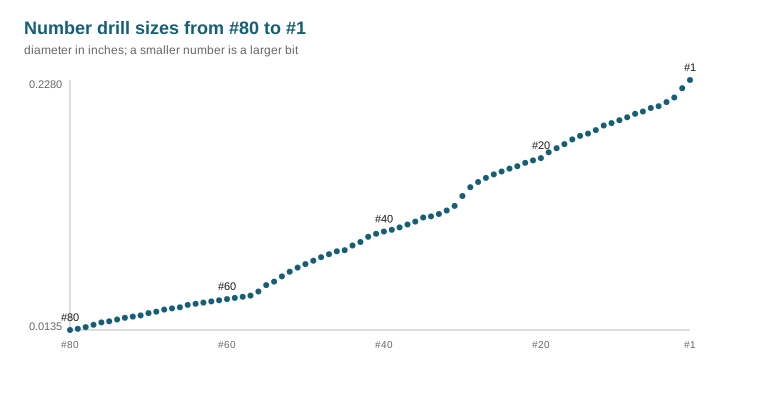
A #1 drill bit is 0.2280 in, which is 5.791 mm. Number drills run from #80 at 0.0135 in up to #1 at 0.2280 in, so a smaller number is always a larger bit.
What is a #7 drill bit in inches and millimetres?
A #7 drill bit is 0.2010 in, which is 5.105 mm. Number drills run from #80 at 0.0135 in up to #1 at 0.2280 in, so a smaller number is always a larger bit.
What is a #13 drill bit in inches and millimetres?
A #13 drill bit is 0.1850 in, which is 4.699 mm. Number drills run from #80 at 0.0135 in up to #1 at 0.2280 in, so a smaller number is always a larger bit.
This page is an archival note for informational purposes only. It does not offer representation, evaluate claims, or create a professional relationship.