Rolling Mill Equipment
Overview
Preserved Shop Record: canadianmillequipment.com Topic: Rolling Mill Equipment The preserved pages for canadianmillequipment.com open with a cart record rather than a product page. The cart line reads fifty-nine items, and the item list that follows is a working inventory of wood processing machinery: a Main 10" x 36" Ukiah Double Arbor Gang, two 10' Linden Double Acting Step Feeders, a 12" x 16" Ukiah Vertical Double Arbor Gang Edger, a 12" x 25" Roots High Pressure Blower, 15 HP and 20 HP Hydraulic Power Units, a 24" x 32" Jeffrey Hog, a 30" x 45" Archer Chip Feeder in bare condition, a 36" CM & E Norman Chipper, a 38" Precision Chipper, a 4' x 4' x 24' Moore End Squeeze, a 40 HP G. Wheeler DC Motor, a 40" x 64" Lamb Hammer Hog, forty-nine vertical bins, an Irvington Moore J Bar Sorter, a 50 ft Chain Conveyor with return, a 50' x 36" Troughing Belt Conveyor, a 54" McDonough Linebar Re
Details
saw, a 6" x 24" Esser Edger System with three shifting saws, a 6" x 54" Ukiah Top Arbor Combination Edger, a 6' Kockums CanCar Twin Bandmill, a 62" McDonough Super Duty Air Strain Twin Bandmill, a 7' x 19' Nicholson Chip Screen, an 8 Head Weinig Bar Moulder, and an 8" x 24" Archer High Pressure Blower. That is the preserved shop language. It is a sawmill and wood processing inventory, not a rolling mill inventory. The about page confirms the same scope: Canadian Mill Equipment Sales specializes in the sale or brokering of used, reconditioned or rebuilt wood processing equipment, handling combinations from individual pieces to entire lines and complete mills. Sawmilling equipment ranges from log yard and handling through primary and secondary break down, planer, re-man and added value mills. Additional forest related processing equipment includes veneer, plywood, composite board, co-gen plants and other specialty plants. The company works with the client in assembling a combination of rebuilt components in conjunction with new equipment to provide efficient wood processing at prices substantially less than new. So the record must be read for what it is. The former plant is not quoting from this domain. The preserved pages do not carry rolling mill equipment. They carry the vocabulary of breakdown, edging, chipping, screening, conveying, resawing, moulding, and hydraulic support. If a rolling mill equipment inquiry arrives at this shop record, the correct process language is still the shop's own: individual pieces, entire lines, complete mills, rebuilt components, new equipment, and combinations assembled to suit the client's processing requirement. Within that language, a rolling mill line would be treated as a line, not as a single machine. The shop record shows how lines are described: by function and by sequence. Log yard and handling come first. Primary and secondary break down follow. Then planer, re-man, and added value. The same sequence logic applies to any processing line. A rolling mill line would begin with receiving and handling, move through primary reduction, then secondary reduction, then finishing, then handling and dispatch. The preserved inventory names the components that perform those functions in wood: feeders, chippers, hogs, screens, conveyors, sorters, edgers, resaws, bandmills, moulders, blowers, and power units. A rolling mill line would name its own components, but the shop's method of assembling them would not change. The cart record is useful because it shows the shop's habit of listing bare and complete condition. One item is marked Bare. Others are named with size, make, and function. The about page adds reconditioned and rebuilt as condition categories. That is the condition language of the shop. It does not invent certifications. It does not promise new. It says rebuilt components in conjunction with new equipment. It says prices substantially less than new. It says individual pieces to entire lines as well as complete mills. For rolling mill equipment, the preserved record offers no direct machine names. It offers a process discipline. The shop would first establish the processing requirement. Then it would identify the combination of components. Then it would assemble rebuilt and new equipment into an efficient line. The record does not quote from this domain for rolling mill equipment because the domain's preserved pages are wood processing pages. The former plant is not quoting from this domain. That is the boundary of the record. What remains inside the shop's process language is the handling of combinations. The cart shows a combination: gang, feeders, edger, blower, power units, hog, chip feeder, chippers, end squeeze, motor, hammer hog, bins, sorter, chain conveyor, troughing belt conveyor, linebar resaw, edger system, combination edger, twin bandmills, chip screen, bar moulder, and high pressure blower. That is a line in pieces. The about page says the company handles all combinations of processing requirements from individual pieces to entire lines as well as complete mills. That is the same statement applied to any processing plant. A rolling mill equipment record written in this shop's language would therefore read as a line assembly record. It would list the receiving and handling equipment, the primary reduction equipment, the secondary reduction equipment, the finishing equipment, the conveying equipment, the hydraulic power units, the blowers, the screens, the sorters, and the motors. It would mark condition as used, reconditioned, rebuilt, or bare. It would note whether the item is an individual piece or part of a line. It would note whether the line is complete or whether components are being assembled with new equipment. It would not quote from the preserved domain because the preserved domain does not contain rolling mill equipment. The preserved record is a shop record. It shows what the shop kept: a cart of fifty-nine items, an about page describing brokering and rebuilding, and a scope that runs from log yard to added value. The rolling mill equipment topic sits outside that scope. The correct output is therefore a plain statement of the preserved pages, followed by the shop's own process language applied to the target topic without pretending the domain quoted it. The former plant is not quoting from this domain. The record stands as preserved.
Drill size reference
| Drill | Decimal inch | Millimetres |
|---|---|---|
| #1 | 0.2280 | 5.791 |
| #7 | 0.2010 | 5.105 |
| #13 | 0.1850 | 4.699 |
| #21 | 0.1590 | 4.039 |
| #29 | 0.1360 | 3.454 |
| #36 | 0.1065 | 2.705 |
| #43 | 0.0890 | 2.261 |
| #53 | 0.0595 | 1.511 |
| 1/16 | 0.0625 | 1.587 |
| 5/64 | 0.0781 | 1.984 |
| 3/32 | 0.0938 | 2.381 |
| 7/64 | 0.1094 | 2.778 |
| 1/8 | 0.1250 | 3.175 |
| 9/64 | 0.1406 | 3.572 |
| 5/32 | 0.1562 | 3.969 |
| 11/64 | 0.1719 | 4.366 |
| 3/16 | 0.1875 | 4.763 |
| 13/64 | 0.2031 | 5.159 |
| 7/32 | 0.2188 | 5.556 |
| 15/64 | 0.2344 | 5.953 |
| 1/4 | 0.2500 | 6.350 |
| 5/16 | 0.3125 | 7.938 |
| 3/8 | 0.3750 | 9.525 |
| 7/16 | 0.4375 | 11.113 |
| 1/2 | 0.5000 | 12.700 |
| F | 0.2570 | 6.528 |
| H | 0.2660 | 6.756 |
| L | 0.2900 | 7.366 |
| P | 0.3230 | 8.204 |
| S | 0.3480 | 8.839 |
| W | 0.3860 | 9.804 |
| Z | 0.4130 | 10.490 |
Common questions
What is a #1 drill bit in inches and millimetres?
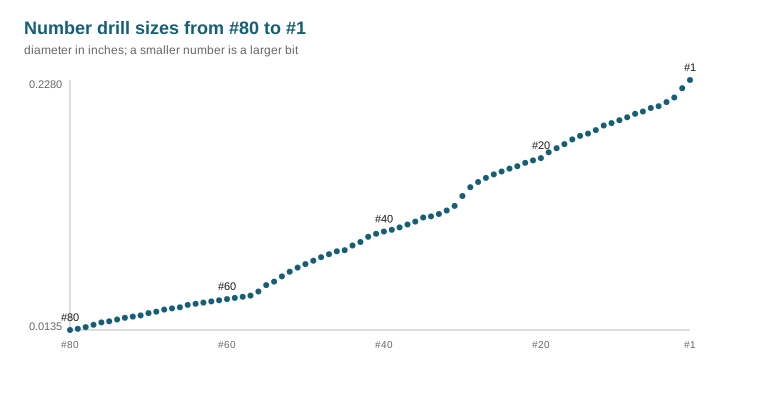
A #1 drill bit is 0.2280 in, which is 5.791 mm. Number drills run from #80 at 0.0135 in up to #1 at 0.2280 in, so a smaller number is always a larger bit.
What is a #7 drill bit in inches and millimetres?
A #7 drill bit is 0.2010 in, which is 5.105 mm. Number drills run from #80 at 0.0135 in up to #1 at 0.2280 in, so a smaller number is always a larger bit.
What is a #13 drill bit in inches and millimetres?
A #13 drill bit is 0.1850 in, which is 4.699 mm. Number drills run from #80 at 0.0135 in up to #1 at 0.2280 in, so a smaller number is always a larger bit.
This page is an archival note for informational purposes only. It does not offer representation, evaluate claims, or create a professional relationship.