Stainless Steel Fabrication
Overview
PRESERVED SHOP RECORD Domain: canadianmillequipment.com Subject: stainless steel fabrication Status: former plant, not quoting from this domain The preserved pages for this shop read like a yard inventory rather than a brochure. The cart page lists fifty-nine items, and the names are the language of a working mill: a 10" x 36" Ukiah double arbor gang, a 10' Linden double acting step feeder, a 12" x 16" Ukiah vertical double arbor gang edger, a 12" x 25" Roots high pressure blower, hydraulic power units at 15 HP and 20 HP, a 24" x 32" Jeffrey hog, a 30" x 45" Archer chip feeder bare, a 36" CM & E Norman chipper, a 38" Precision chipper, a 4' x 4' x 24' Moore end squeeze, a 40 HP G. Wheeler DC motor, a 40" x 64" Lamb hammer hog, forty-nine vertical bins, an Irvington Moore J bar sorter, a fifty-foot chain conveyor with return, a 50' x 36" troughing belt conveyor, a 54" McDonough linebar r
Details
esaw, a 6" x 24" Esser edger system with three shifting saws, a 6" x 54" Ukiah top arbor combination edger, a 6' Kockums CanCar twin bandmill, a 62" McDonough super duty air strain twin bandmill, a 7' x 19' Nicholson chip screen, an eight head Weinig bar moulder, and an 8" x 24" Archer high pressure blower. That list is the shop's process language. It tells you what the plant handled: log yard and handling, primary and secondary break down, planer, re-man and added value mills, plus veneer, plywood, composite board, co-gen and other specialty plants. The about page says the company specialized in the sale or brokering of used, reconditioned or rebuilt wood processing equipment, from individual pieces to entire lines and complete mills. It also says the shop would work with a client to assemble a combination of rebuilt components with new equipment to provide efficient wood processing at prices substantially less than new. Stainless steel fabrication sits inside that same process language. It is not a separate trade pasted onto a mill. It is what happens when the wetted, abrasive, acidic or high-wear side of a wood processing line needs a surface that will not pit, stain, gall or carry over. In a plant that runs green wood, bark, chips, sawdust, veneer, plywood glue, composite board resin, co-gen fly ash and wash-down water, stainless is chosen for the places where carbon steel would fail early or contaminate the product. The preserved inventory gives the fabrication cues. A chipper, a hog, a hammer hog, a chip screen, a blower, a conveyor, a sorter, an edger, a resaw, a bandmill, a moulder, a feeder, an end squeeze, a hydraulic power unit. Each of those has a stainless fabrication scope when the duty calls for it. The work starts with the process side: what is moving, at what size, at what moisture, at what temperature, and what the plant needs to keep clean. From there the shop lays out plate, sheet, bar, tube and pipe in the grades the process allows. The fabrication language is cut, form, fit, weld, grind, passivate, and assemble. For a chipper or hog, stainless fabrication usually means the wear liners, the chute, the discharge transition, the inspection doors, the bolt-on wear plates and the replaceable edges. The base machine may be carbon steel, but the surfaces that see the chip stream are stainless where the plant wants corrosion resistance and wash-down. The fabrication follows the existing bolt pattern and the existing throat opening. The shop does not redesign the machine. It reproduces the interface so the rebuilt component drops into the line. For a blower or a high pressure blower, stainless fabrication is the housing, the inlet box, the outlet transition, the flange faces and the wear back. The impeller may be a separate scope. The housing is rolled, fitted, tacked, checked for round and for clearance, then welded out. The flange faces are machined or faced flat so the gaskets seat. The drain and clean-out points are placed where the plant can reach them. For a conveyor, a troughing belt conveyor or a chain conveyor with return, stainless fabrication is the pans, the skirts, the chute liners, the discharge spouts, the dribble chutes and the covers. The frame may stay painted carbon steel. The stainless is where the material slides, where the water sits, and where the plant washes down. The fabrication is set by the belt width, the trough angle, the chain return path and the head and tail pulley centers. For a screen, a chip screen or a sorter, stainless fabrication is the deck frames, the side plates, the discharge lips, the dividers and the replaceable wear strips. The openings and the deck pitch are fixed by the process. The stainless is there for the wet side and for the fines that cling and corrode. For an edger, a resaw, a bandmill or a moulder, stainless fabrication is the guards, the chip chutes, the sawdust hoods, the coolant pans, the drip trays and the air strain components where the plant wants corrosion resistance. The fabrication must clear the saw line, the feed rolls, the pressure rolls and the shifting saws. The shop works from the existing mounting points and the existing clearance envelope. The process language also covers the small parts that decide whether a line runs: the hydraulic power unit reservoirs and tanks, the drip pans, the drain boxes, the transition pieces, the expansion joints, the handrails, the ladders, the platforms and the grating. Stainless fabrication for those is plate and structural work. It is cut, formed, fitted, welded, cleaned and assembled. The weld finish is set by the service: a sanitary or product-contact surface gets a smoother finish, a wear surface gets a heavier pass, a structural surface gets a sound weld and a clean edge. The shop's method is the same across all of it. It starts from the preserved record of what the plant already had. It reads the machine, the line and the duty. It selects the stainless grade and the thickness for the wear and the corrosion. It lays out the part from the existing interface. It cuts, forms, fits and welds. It checks the fit against the mating piece. It cleans and passivates where the service calls for it. It assembles the rebuilt component with new hardware and new wear parts where needed. Then it sends the piece back into the line. That is the stainless steel fabrication side of this shop record. It is not a catalog of grades or a list of certifications. It is the work of making the wetted, abrasive and wash-down parts of a wood processing line in a material that will hold up. The preserved pages show the machines. The process language shows the fabrication. The two belong together.
Drill size reference
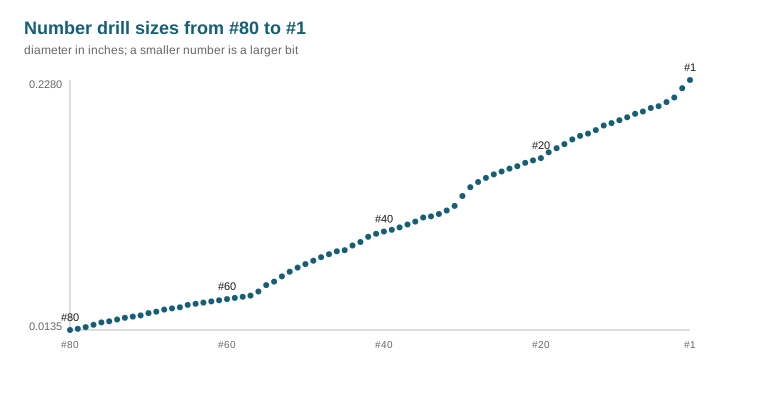
| Drill | Decimal inch | Millimetres |
|---|---|---|
| #1 | 0.2280 | 5.791 |
| #7 | 0.2010 | 5.105 |
| #13 | 0.1850 | 4.699 |
| #21 | 0.1590 | 4.039 |
| #29 | 0.1360 | 3.454 |
| #36 | 0.1065 | 2.705 |
| #43 | 0.0890 | 2.261 |
| #53 | 0.0595 | 1.511 |
| 1/16 | 0.0625 | 1.587 |
| 5/64 | 0.0781 | 1.984 |
| 3/32 | 0.0938 | 2.381 |
| 7/64 | 0.1094 | 2.778 |
| 1/8 | 0.1250 | 3.175 |
| 9/64 | 0.1406 | 3.572 |
| 5/32 | 0.1562 | 3.969 |
| 11/64 | 0.1719 | 4.366 |
| 3/16 | 0.1875 | 4.763 |
| 13/64 | 0.2031 | 5.159 |
| 7/32 | 0.2188 | 5.556 |
| 15/64 | 0.2344 | 5.953 |
| 1/4 | 0.2500 | 6.350 |
| 5/16 | 0.3125 | 7.938 |
| 3/8 | 0.3750 | 9.525 |
| 7/16 | 0.4375 | 11.113 |
| 1/2 | 0.5000 | 12.700 |
| F | 0.2570 | 6.528 |
| H | 0.2660 | 6.756 |
| L | 0.2900 | 7.366 |
| P | 0.3230 | 8.204 |
| S | 0.3480 | 8.839 |
| W | 0.3860 | 9.804 |
| Z | 0.4130 | 10.490 |
Common questions
What is a #1 drill bit in inches and millimetres?
A #1 drill bit is 0.2280 in, which is 5.791 mm. Number drills run from #80 at 0.0135 in up to #1 at 0.2280 in, so a smaller number is always a larger bit.
What is a #7 drill bit in inches and millimetres?
A #7 drill bit is 0.2010 in, which is 5.105 mm. Number drills run from #80 at 0.0135 in up to #1 at 0.2280 in, so a smaller number is always a larger bit.
What is a #13 drill bit in inches and millimetres?
A #13 drill bit is 0.1850 in, which is 4.699 mm. Number drills run from #80 at 0.0135 in up to #1 at 0.2280 in, so a smaller number is always a larger bit.
This page is an archival note for informational purposes only. It does not offer representation, evaluate claims, or create a professional relationship.